
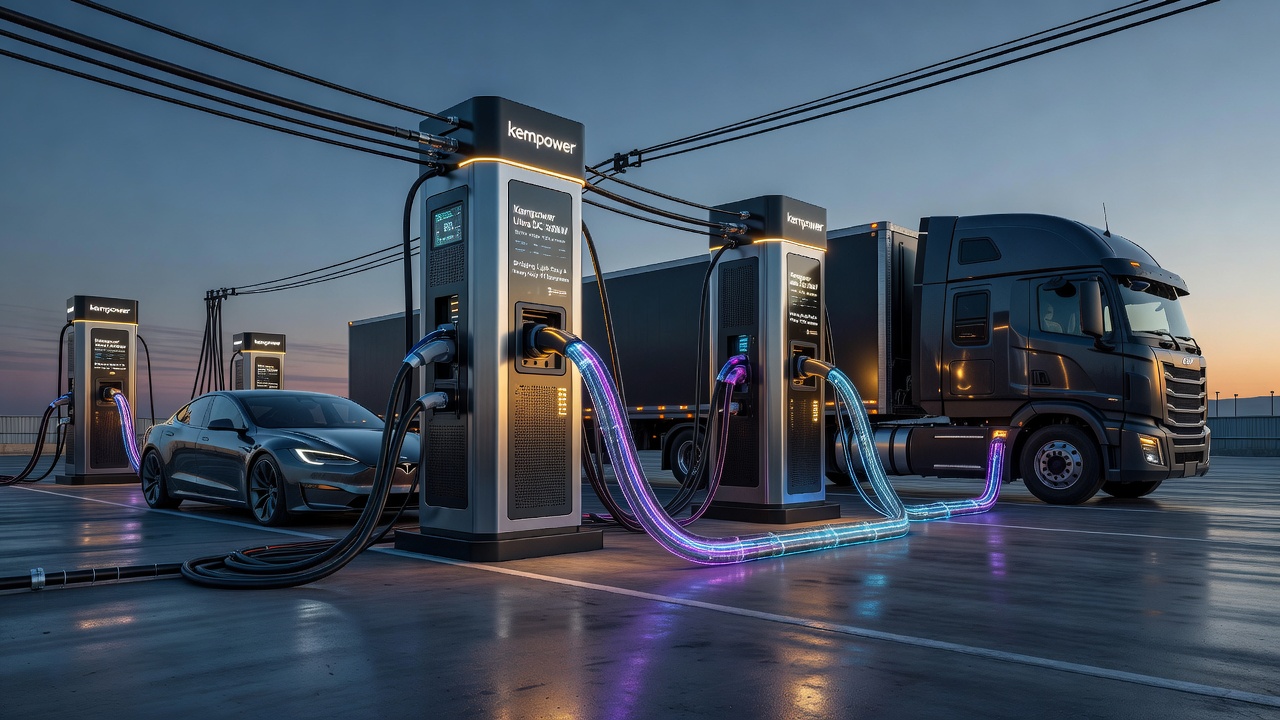
Kempower has introduced a charging dispenser that can serve a passenger car and a heavy-duty electric truck at the same site, without requiring separate infrastructure for each. The Mega Satellite Flex, unveiled this week at the Unplug & Recharge event held during ACT Expo, supports both the established CCS standard at up to 560 kW and the emerging Megawatt Charging System at up to 1.2 MW. It is Kempower's first unit built to handle either standard, a design choice that reflects where the charging industry currently stands: caught between the technology that has powered electric cars for a decade and the higher-capacity system now being built for trucks.
That transition period is the real story here. CCS, or Combined Charging System, has been the default connector for battery electric vehicles across much of North America and Europe for years, and it remains the standard most cars on the road today rely on. But heavy-duty trucks need far more energy delivered far more quickly to make electrification workable for depots and highway corridors, which is why MCS was developed. Rather than betting entirely on one standard or asking operators to build two parallel networks, Kempower's dual-format approach lets a single dispenser adapt as demand shifts. In a market where some companies are still comparing infrastructure strategies the way consumers might weigh a sprawling service against a smaller but faster network, Kempower is wagering that flexibility, not scale alone, will define the winners.
Why Dual-Standard Charging Matters Now
Building charging infrastructure is capital-intensive, and site owners are wary of installing hardware that becomes obsolete or narrowly useful within a few years. A dispenser that switches between CCS and MCS reduces that risk. Operators can install one system today, serve passenger cars and light commercial vehicles immediately, and reallocate capacity toward trucks as MCS-equipped fleets scale up. That avoids the cost and disruption of a second buildout later, which matters for return on investment, especially at highway stops and logistics hubs where land and grid capacity are already constrained.
The unit also supports 800-volt electric vehicles, a growing segment of the passenger and commercial market that can accept significantly faster charging than older 400-volt architectures allow. By supporting both voltage classes and both connector standards in one cabinet, Kempower is effectively future-proofing a single piece of hardware against multiple trajectories the EV market could take.
Technical Specifications and Deployment
The Mega Satellite Flex is rated for up to 1,500 amps on MCS and 700 amps on CCS, with cable lengths of 5 meters for CCS and 2.7 meters for MCS connections. An optional payment terminal can be integrated directly into the unit, and it is designed to work within Kempower's existing distributed charging architecture, meaning operators already using Kempower systems can add the new dispenser without reengineering their sites.
- CCS charging: up to 560 kW, 700 amps, 5-meter cable
- MCS charging: up to 1.2 MW, 1,500 amps, 2.7-meter cable
- Compatible with 800-volt EV architectures
- Integrates with Kempower's distributed charging systems
What Comes Next
Kempower expects the Mega Satellite Flex to reach North American and European markets in July 2026, giving fleet operators and charging network developers over a year to plan deployments. Whether MCS becomes the dominant standard for heavy-duty trucking or CCS extends further into that space remains an open question, and hardware that hedges against either outcome is likely to appeal to operators wary of picking the wrong side of a still-unsettled technology race.