
Chicken Crossing Road: Is It Legal? Road-Crossing Rules and Chicken Road Game Legality
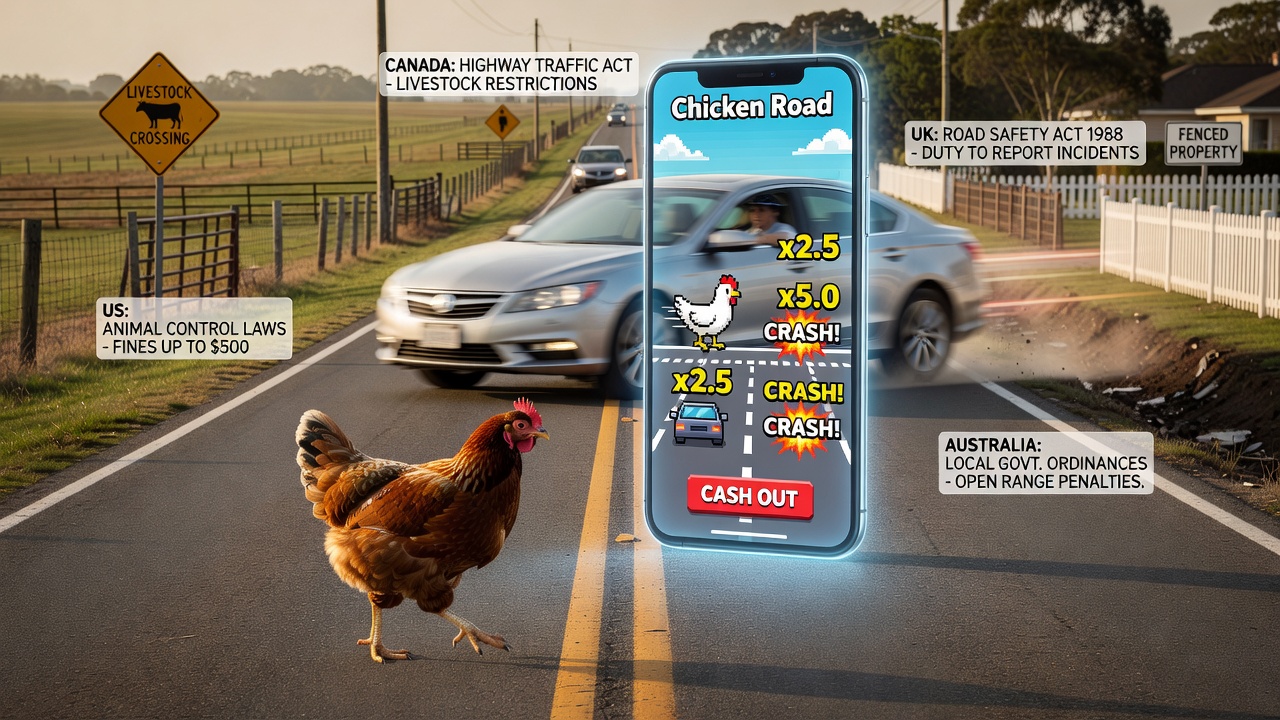
A chicken crossing a highway is not a joke to the driver who has to brake for it. In most jurisdictions across the United States, Canada, the United Kingdom, and Australia, livestock and poultry wandering onto public roads sit at the intersection of animal control law, traffic code, and property liability. The old riddle asks why the chicken crossed the road. The more pressing modern question is what happens legally when it does - and, separately, what happens when the phrase "chicken road" refers not to a barnyard escape but to a betting game built around the same absurd premise.
These two topics get tangled together online, and for good reason. Search interest in road crossing legal questions has grown alongside curiosity about the chicken road game, a wagering format where players guide a digital chicken across lanes of traffic, cashing out before it gets flattened. One is a matter of municipal ordinances and farm liability. The other is a matter of gambling regulation and platform trustworthiness. Readers curious about the game's fairness often land on independent reviews such as this breakdown of whether the chicken road game legal status holds up under scrutiny, and that distinction matters before anyone deposits money.
This piece separates the real-world rules governing animals on roadways from the regulatory questions surrounding the digital game that borrowed its name. Both deserve clear, accurate answers - not folklore.
Understanding the Chicken Crossing Road Phenomenon
Why Chickens End Up on Roads
Chickens are not particularly strategic animals, but they are territorial and easily startled. A loose latch, a predator scare, or simple curiosity about open ground on the other side of a fence is usually enough. Free-range operations and backyard coops sited near public roads report this far more often than confined operations, since birds with outdoor access have both the motivation and the physical opportunity to wander.
The Real-World Risks Involved
A chicken crossing road traffic creates a small but real hazard. Drivers swerving to avoid an animal cause a disproportionate share of single-vehicle accidents involving no other person or vehicle. Unlike a deer, a chicken rarely causes serious vehicle damage on impact, but the swerve reaction it triggers can send a car into a ditch, oncoming lane, or roadside obstacle just as easily as a larger animal would.
Common Misconceptions About Animal Crossings
Many people assume any animal on a road is automatically the owner's legal problem, full stop. That is not universally true. Liability frequently depends on whether the owner exercised reasonable care in containment, whether the road was fenced or marked as animal-crossing territory, and whether local law treats chickens the same as larger livestock such as cattle or horses. The rules are far more localized than most people expect.
Is a Chicken Crossing a Road Actually Legal?
Traffic Law Perspective
Traffic codes are written for vehicles and pedestrians, not poultry. An animal that wanders onto a road is not committing a violation in any meaningful legal sense - animals cannot be cited. The road crossing legal question, then, is not about the chicken's conduct but about the human obligations surrounding it: does the owner face a citation for failing to contain livestock, and does the driver face liability if they strike the animal while speeding or driving carelessly?
Local and State Regulations
Regulation varies sharply by location. Rural counties with agricultural zoning often have "open range" or "fence-out" laws, meaning drivers are expected to watch for livestock and owners bear little responsibility if an animal reaches a public road. Suburban and urban municipalities tend to reverse that logic with "fence-in" requirements, placing the burden squarely on the animal's owner to prevent escape, backed by fines for repeat violations.
What Happens If a Chicken Causes an Accident
When a collision does occur, insurance adjusters and small-claims courts typically look at three factors: whether the owner had a documented history of escapes, whether reasonable fencing existed, and whether the road was marked with any livestock warning signage. A first-time escape with no prior complaints rarely results in owner liability. A pattern of repeated wandering, especially after warnings from neighbors or animal control, shifts the balance considerably.
- Fence-out states generally place risk on the driver
- Fence-in municipalities generally place risk on the owner
- Repeated incidents almost always increase owner liability regardless of jurisdiction
- Documented warning signs can reduce driver-side claims against an owner
What Is the Chicken Road Game?
Core Mechanics of the Game
The chicken road game is a digital wagering format built on a simple risk escalation loop. A chicken icon advances across a series of lanes, and each successful lane crossed increases the potential payout multiplier. Players choose when to cash out; wait too long, and the chicken meets a virtual vehicle, wiping out the round. It is a close cousin of "crash" style betting games, dressed in a road-crossing theme for visual appeal.
Where and How It's Played
These games appear on online betting platforms that also offer traditional casino products such as slots and card games. They require an account, a deposit, and are typically played in quick succession - rounds last seconds, not minutes - which is part of their appeal to players seeking fast-paced wagering rather than a drawn-out game session.
Why the Game Has Gained Popularity
Simplicity drives adoption. There is no card-counting, no complex ruleset, and no ambiguity about the objective. Players understand instantly that further crossings mean higher risk and higher reward. That immediacy, combined with the visual humor of an animated chicken dodging traffic, has made the format spread quickly across betting platforms that cater to casual, high-frequency players.
Chicken Road Game Legality Explained
Gambling Laws That Apply
Chicken game legality is governed by the same gambling regulations that apply to any real-money wagering product: licensing requirements, age verification, and jurisdictional restrictions on online betting. A game's theme has no bearing on its legal status. What matters is whether the operator holds a valid gambling license in the player's jurisdiction and whether that jurisdiction permits online wagering at all.
Licensing and Fair Play Standards
A legal chicken road game operates under a license issued by a recognized gambling authority, uses a certified random number generator, and publishes its return-to-player rate. Reputable platforms submit their game outcomes to independent auditing firms that verify the randomness of each round. Absent that certification, there is no reliable way to confirm the chicken's "crossing" outcomes are not manipulated in the house's favor.
Differences Between Legal and Unlicensed Platforms
Unlicensed platforms often mimic the visual style of legitimate games while operating outside any regulatory oversight. Warning signs include the absence of a visible license number, no independent audit certification, unclear withdrawal terms, and customer support that cannot answer direct questions about licensing jurisdiction. Players who bypass this due diligence risk both financial loss and having no legal recourse if a dispute arises.
- Verify the operator's license number against the issuing authority's public register
- Check for independent RNG certification from a recognized testing lab
- Read withdrawal terms before depositing, not after a big win
- Confirm the platform accepts players from your specific jurisdiction legally
How to Verify If a Chicken Road Game Is Legal
Checking Licensing Information
Every legitimate operator displays licensing details, usually in the site footer or a dedicated "about" page. This includes the licensing body's name, a license number, and often a direct link to verify that number on the regulator's own website. If this information is missing, vague, or unverifiable, treat that as a serious red flag rather than an oversight.
Reading Terms and Conditions Carefully
Terms and conditions reveal more about a platform's legitimacy than its marketing does. Look specifically at withdrawal limits, wagering requirements attached to bonuses, and dispute resolution procedures. A platform that buries these details in dense legal language, or omits them entirely, is signaling something worth taking seriously.
Recognizing Trustworthy Platforms
Trustworthy operators are transparent by default. They publish their return-to-player percentages, name their auditing partners, and respond clearly to direct questions about jurisdictional restrictions. Independent reviews and player forums often surface real experiences with payout speed and customer service responsiveness, which tend to be more revealing than anything on the platform's own marketing pages.
Frequently Asked Questions
Can I be fined if my chicken causes a road accident?
Yes, in fence-in jurisdictions where owners are legally required to contain livestock. The fine amount and liability exposure depend on local ordinances, whether the escape was a first occurrence, and whether the owner had prior warnings from animal control or neighbors.
Is it illegal to swerve to avoid a chicken on the road?
Swerving itself is not illegal, but causing an accident while doing so can still result in a citation for reckless or careless driving if the maneuver was excessive relative to the actual hazard. Courts generally evaluate whether a reasonable driver would have reacted the same way.
Is the chicken road game legal in my country?
It depends entirely on your jurisdiction's online gambling laws and whether the specific operator holds a license valid there. Always confirm licensing status directly with the platform and cross-check it against the regulator's public register before depositing funds.
How do I know if a chicken road game is rigged?
Check whether the platform publishes independent RNG certification and a return-to-player rate. Games without third-party auditing offer no verifiable proof of fairness, regardless of how the outcomes appear over a short playing session.
Does homeowner's insurance cover damage from livestock escapes?
Many standard homeowner policies exclude farm animal liability, requiring a separate farm or livestock liability rider. Anyone keeping poultry or livestock near a public road should confirm coverage specifics directly with their insurer rather than assuming standard coverage applies.
What age restrictions apply to playing a legal chicken road game?
Licensed gambling platforms uniformly require players to be at least 18, and in some jurisdictions 21, verified through identity checks at registration or withdrawal. Platforms that skip this verification step are operating outside standard regulatory requirements.