
Over 1.5 Goals Explained: Meaning of 1.5 Total Goals, Match Goals, and Betting Rules
Roughly seven out of ten football matches finish with three or more total goals scored between both sides. That single fact explains why over 1.5 goals has become one of the most heavily backed markets in football betting, favored by casual punters and professional traders alike. It sits in a comfortable middle ground between the near-certainty of over 0.5 goals and the riskier over 2.5 line, making it a frequent entry point for anyone new to goal-based markets.
Yet plenty of bettors place wagers on this market without fully understanding how it settles, what happens when a match ends 1-0, or why the ".5" appears in the first place. For newcomers exploring over 1.5 goals meaning, the concept can look deceptively simple until a specific scoreline forces a rule check mid-match. A clear grasp of the settlement logic saves confusion and, more importantly, prevents costly misreads of odds. Sites offering detailed breakdowns, such as the explanation on over 1.5 goals meaning, are useful reference points before placing real money on the line.
This piece walks through the mechanics, the scenarios that trip people up, and the strategic reasoning that separates disciplined bettors from those simply guessing. By the end, the logic behind 1.5 total goals will feel less like a betting quirk and more like straightforward arithmetic.
What Does Over 1.5 Goals Mean in Football Betting?
The Basic Definition
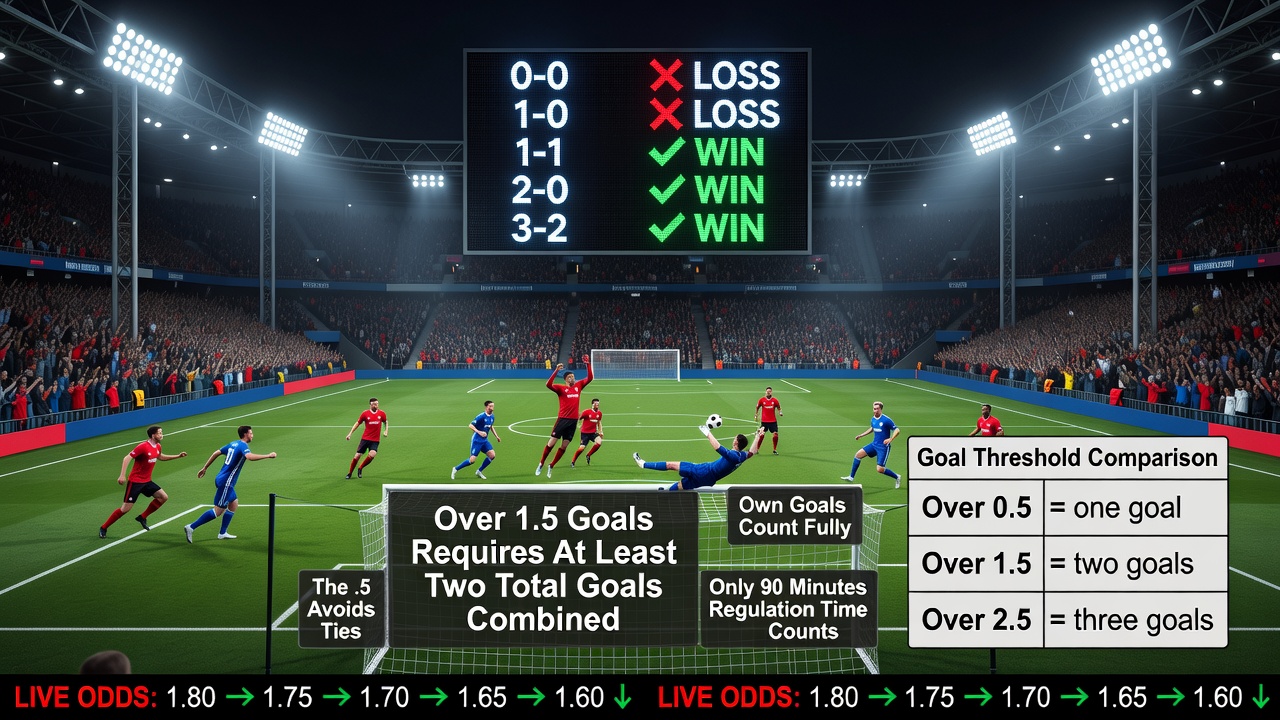
Over 1.5 goals is a wager on the total number of goals scored in a match by both teams combined, not just one side. For the bet to win, the match must produce at least two goals in total. The ".5" is not a real half-goal; it exists purely to eliminate the possibility of a tie in the bet itself. Since goals in football are always whole numbers, the half-point ensures every match resolves the wager cleanly as either a win or a loss.
Why the ".5" Exists
Betting markets use fractional lines specifically to avoid a push, which is a refunded stake caused by a tied outcome. If the line were simply "over 2 goals," a match ending with exactly two goals would create a settlement problem. Setting the threshold at 1.5 goals over removes that ambiguity entirely. Two goals clears the line; one goal does not.
Where This Market Sits Among Other Goal Lines
Over 1.5 goals occupies the space between the safer over 0.5 goals market, which only requires a single goal, and the more demanding over 2.5 goals market, which needs three or more. This positioning makes it attractive for bettors who want better odds than the almost-guaranteed 0.5 line without accepting the added risk that comes with needing three goals.
- Over 0.5 goals: settles with just one goal scored
- Over 1.5 goals: requires two or more goals combined
- Over 2.5 goals: requires three or more goals combined
Understanding 1.5 Total Goals in a Match
Counting Goals From Both Teams
The phrase 1.5 total goals refers strictly to the combined score, regardless of which team scored what. A 2-0 win counts the same as a 1-1 draw for this market: both produce two total goals. Bettors sometimes mistakenly assume the bet relates to one team's output, but the market has nothing to do with which side wins the match.
Own Goals and Their Effect on the Count
Own goals count toward the total exactly like any other goal. If a defender accidentally scores against his own team, that goal still pushes the total higher and can single-handedly settle an over 1.5 goals bet. Bettors watching a scoreless match should treat any own goal with the same weight as a striker's finish.
Extra Time and Penalty Shootouts
In standard match markets, only goals scored during the 90 minutes plus regulation stoppage time count. Extra time goals in knockout competitions typically do not count toward this market unless the specific bet explicitly includes extra time, and penalty shootout goals never count, since a shootout is a tiebreaker rather than part of match play.
How Over 1.5 Match Goals Bets Are Settled
Winning Scenarios
Any final score with a combined total of two or more goals wins an over 1.5 match goals bet. This includes lopsided results like 4-0 as well as tight ones like 1-1. The distribution of goals between the two teams is irrelevant; only the sum matters.
Losing Scenarios
The bet loses in exactly two situations: a 0-0 draw or a 1-0 result in either direction. These are the only outcomes where the combined goal total fails to reach two. Everything else, no matter how the goals are distributed, results in a win for the over side.
Common Scoreline Examples
- 0-0: bet loses (zero total goals)
- 1-0 or 0-1: bet loses (one total goal)
- 1-1: bet wins (two total goals)
- 2-0: bet wins (two total goals)
- 3-2: bet wins (five total goals)
Seeing these examples side by side makes the goals over 1.5 explanation far more intuitive than reading the rule in isolation. The pattern becomes obvious once a few scorelines are laid out together.
Betting Over 1.5 Goals Rules and Key Considerations
Standard Rules Across Bookmakers
Most bookmakers apply identical settlement logic for this market, since the rule is mathematically fixed rather than open to interpretation. Differences between platforms tend to show up in odds pricing rather than settlement criteria. Still, reading the specific terms for each bookmaker before betting is a sound habit, particularly around how they treat abandoned or postponed matches.
Live Betting Adjustments
Odds for over 1.5 goals shift constantly during a live match based on the current score and time remaining. A scoreless first half will push the odds for the over outward, reflecting reduced time for two goals to occur, while an early goal often shortens them considerably since only one more goal is needed. Reading these shifts helps bettors judge whether the market is offering fair value at any given moment.
Cash Out and Partial Settlement Features
Many platforms allow bettors to cash out a bet before the match ends, locking in a partial profit or limiting a loss based on the live probability of the bet winning. This feature does not change the underlying settlement rules; it simply offers an exit point before the natural conclusion of the wager.
Strategic Approach to Betting Over 1.5 Goals
Analyzing Team Scoring Tendencies
Teams with attacking styles, high pressing systems, or weak defensive records tend to produce matches that clear the 1.5 goals over threshold more consistently. Reviewing recent scoring patterns for both teams involved, rather than relying on reputation alone, gives a more accurate read on how likely a match is to produce multiple goals.
Considering League and Competition Context
Some leagues are structurally higher scoring than others due to defensive quality, playing style, or competitive balance. A league known for open, attacking football will naturally see the over 1.5 match goals market hit more often than one built around disciplined, low-scoring defensive contests. Adjusting expectations by competition avoids applying a one-size-fits-all approach.
Combining With Other Markets
Some bettors pair over 1.5 goals with both-teams-to-score markets or with specific correct-score predictions to build accumulators with better combined odds. This approach carries higher risk since every leg must win, but it reflects how the 1.5 total goals line often serves as a building block within larger betting strategies rather than a standalone wager.
Managing Stake Size and Expectations
Because over 1.5 goals wins in the large majority of matches across most competitions, odds for this market tend to be shorter than markets like over 2.5 or over 3.5 goals. Bettors chasing bigger returns sometimes overlook this market in favor of riskier ones, but its consistency makes it a reasonable component of a disciplined, long-term betting approach rather than a quick path to large profits.
Frequently Asked Questions
Does a red card or injury affect whether the bet settles?
No. Red cards, injuries, and other match events have no direct bearing on settlement. Only the final combined goal total scored during regulation play determines the outcome, regardless of how those goals came about.
Do goals scored in stoppage time count toward the total?
Yes. Stoppage time added to either half is part of regulation play, and any goals scored during that period count fully toward the combined total used to settle the bet.
What happens if a match is abandoned before full time?
Rules vary by bookmaker, but most void the bet and refund the stake if the match does not reach a point where results are officially recognized. Some platforms settle bets based on the score at the time of abandonment if enough of the match was completed, so checking the specific terms beforehand matters.
Is over 1.5 goals a safer bet than over 2.5 goals?
Generally yes, since it requires one fewer goal to win. This lower risk is reflected in shorter odds, meaning the potential payout is smaller compared to the over 2.5 goals market for the same stake.
Can this market apply to a specific team rather than the whole match?
The standard over 1.5 goals market always refers to the combined total from both teams. Bookmakers offering team-specific versions label them separately, such as "Team A over 1.5 goals," and these operate as distinct markets with their own odds and settlement rules.
Why do odds for this market change so much during a live match?
Odds reflect the changing probability of reaching two total goals as time runs out. An early goal sharply increases that probability, shortening the odds, while a goalless period late in the match pushes the odds out since less time remains for a second goal to arrive.